Notes: Value Category in C++
How does C++ return a class
Usually, allocated spaces are on the caller’s stack. But this varies across ABI. So, in C++, compiling using the same compiler is the only way to avoid the ABI problem. C has a relatively more consistent ABI across different compilers.
Understanding xvalue and prvalue
Talk: [CppDay20] Understanding value categories in C++ (Kris van Rens)
-
Before C++11, xvalue and prvalue are similar: we could steal resources from both of them, and they could both bind by the rvalue reference.
-
The famous diagram illustrates their differences
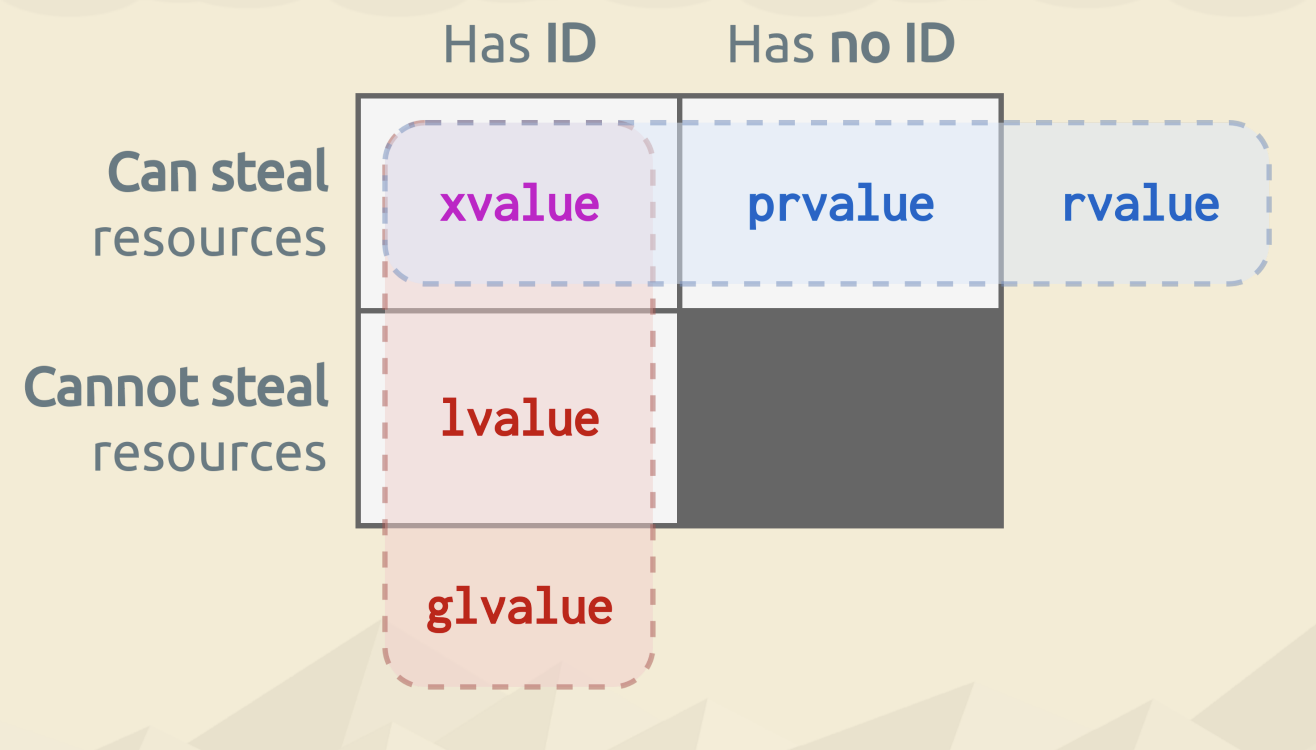
-
-
Since C++17, we need to understand the differences between these two to understand how the standard enforces its rule of optimization (namely copy elision)
- Before C++17, some optimizations are not guaranteed, but most compilers will do them (implementation-defined).
- First thing to notice, the value category is about expressions instead of types (See C++ Abstract Machine)
-
Elisions
- C++17 added mandates to the standard, informally known as: “Guaranteed copy elision”, “Guaranteed return value optimization”, and “Copy evasion”.
- Where can elisions occur?
- In the initialization of an object
- In a return statement
- In a throw expression
- In a catch clause
- Under the hood: how do we guarantee elision?
- Under the rules of C++17, a prvalue will be used only as an unmaterialized recipe of an object until actual materialization is required.
- Temporary materialization (cases where no elision happens)
- A prvalue is an expression whose evaluation initializes/materializes an object
- prvalues are not moved from as they are not materialized
- Why temporary materialization: we want to move resources of some un-materialized entity.
- Without materialization, we can feel free to construct the class in place in memory instead of calling copy/move constructors
- Temporary materialization occurs when
-
Accessing a member of a prvalue
-
Binding a reference to a prvalue (this is how
T &&help us steal the resources) -
Applying sizeof or typeid to a prvalue
struct Person {
    std::string name_;
    unsigned int age_ = {};
};

Person createPerson() {
    std::string name;
    unsigned int age = 0;
    // Get data from somewhere in runtime
    return Person{name, age}; // 1. Initial prvalue expression
}

int main() {
    return createPerson().age_; // 2. Temporary materialization: xvalue
}
-
Return Value Optimization
RVO and NRVO are unofficial terms used by people.
- URVO/RVO
- Refers to the returning of temporary objects from a function. Guarantee to be optimized by C++17 rules.
- NRVO
- Refers to the returning of named objects from a function.
- Have different cases
- Return named variable inside a function without conditions => YES
- Return static variable => NO
- Return the named variable inside a function with conditions, and the returned values are of different names => NO (the compiler doesn’t know how to put them into the returned space)
- Return subclasses => NO (cannot be put into the returned space, must be copied or moved)
- Return arguments => NO (arguments are already in their position. whether or not a function decides to do copy elision is the function’s decision, the caller doesn’t need to know this – think about the translational unit)
- In summary, RVO does not work when there’s no control over the physical location of the object.
- When even NRVO is not possible, it will cause an implicit move
-
Sometimes, if NRVO is possible, DO NOT use a std::move in the return because this disables the NRVO
T noNRVO()
{
    T result;
    return std::move(result);
}

T NRVO(){
    T result;
    return result;
}
-
Differences between xvalue and prvalue when using auto
xvalue and prvalue matter when using decltype deduction rules, for example. What cppreference says: a) if the value category of expression is xvalue, then decltype yields T&&; b) if the value category of expression is an lvalue, then decltype yields T&; c) if the value category of expression is prvalue, then decltype yields T.
In this way, the compiler has a better hint of what kind of expression is coming. And of course, it’s just important in a semantic sense of dealing with expressions.
struct A {};
int main() {
    decltype(auto) a1 = A(); //prvalue, type of a1 is A
    decltype(auto) a2 = std::move(A()); //xvalue, type of a2 is A&&
}